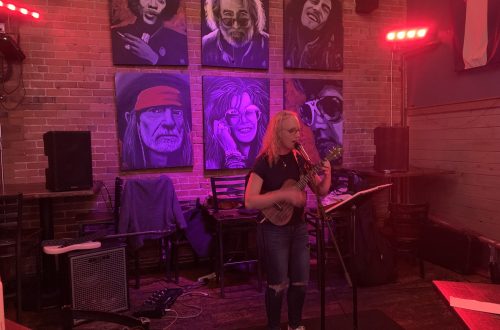
What I Practice When No One Is Listening
When I say “when no one is listening,” I don’t just mean an empty room.
For me, sometimes it’s music without an agenda.
No setlist. No audience. No outcome I’m aiming for.
Just showing up with the instrument and seeing what wants to happen.
For me, this kind of playing is deeply personal — a choose-your-own-adventure type of practice. It’s also where a lot of my real progress lives.
Practice doesn’t always look like drills
I think of practice a little differently than I used to.
If I’m playing with intention — if I’m imagining a performance, shaping dynamics, or focusing on feel — I count that as practice. A performance mindset doesn’t cancel out learning; sometimes it creates it.
Today was one of those days where I wanted to play… but I didn’t know what was going to happen.
So I started where I almost always start when no one’s listening.
Starting with sound, not songs
I picked up the ukulele and began strumming chords. No particular order. No plan.
I let my hands wander until something caught my ear and found a progression I liked.
I stayed there for a while — gently expanding it, shifting the chords, listening to how it felt instead of worrying about where it was going. That alone would have been enough.
Eventually, I reached for my iPad and chose a few songs I wanted to visit:
- Days Like This
- the 1
- Just Like Heaven
- Yellow
- You Don’t Know How It Feels
I wasn’t fully warmed up, so I stayed in familiar territory — songs that let me settle in without fighting the instrument or my voice.
Spot-checking instead of starting over
I played through the songs, noticing where things didn’t quite land.
Instead of starting from the top every time, I stopped and spot-checked specific lines. A lyric that tripped me up. A chord change that felt rushed. A transition that needed a little breathing room.
I worked those moments until they felt ready — not perfect, but reliable.
Performance-ready, for me, doesn’t mean flawless, because it can never be.
It means I trust myself enough to play it for someone else.
Knowing when to stop
When I felt done, I stopped.
No forcing one more song.
No guilt about how long I played.
I got some songs in today, and that’s good enough for me.
That’s what practice looks like when no one is listening: following curiosity, honoring attention, and letting music be a place I can simply arrive — not prove anything.
And tomorrow, I’ll pick it up again and see what happens.
You May Also Like
Another Year Older, Still Practicing
My Favorite ‘Ukulele